
Author: Watson All-Lights in collaboration with Catapila Design
Part 3 — Feature Trees, Planting & Focal Points
In Part 1, we covered driveway lighting and how to create a safe, functional arrival.
In Part 2, we explored pathways and courtyards, focusing on movement, rhythm, and subtle guidance.
This third part shifts the focus again. This is where lighting becomes less about where you go and more about what you see.
Feature lighting is what gives a space depth, contrast, and a sense of intention. It’s the difference between a garden that is simply lit and one that feels designed.
Lighting focal points, not everything. A common mistake in outdoor lighting is trying to illuminate the entire space evenly.
In reality, good lighting design does the opposite. It selects key elements and allows the rest to fall away into shadow.
This might include:
- A feature tree
- Layered planting
- A textured wall
- Architectural elements
By focusing light only where it is needed, you create contrast. And it’s this contrast that gives a garden presence at night.
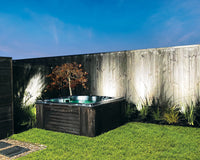
Using trees to create scale and structure. Trees are often the most powerful element in a landscape at night.
During the day, they provide height and structure. At night, they can become the anchor of the entire lighting scheme.
There are two common approaches:
Uplighting

Positioning a fitting at the base of the tree and directing light upward.
This works well for:
- Feature trees with interesting branching
- Specimen planting
- Trees positioned near entertaining areas
Layered uplighting
For larger trees, a single fitting is often not enough.
Using two or more fittings at different angles can:
- Reduce harsh shadows
- Add depth through the canopy
- Create a more natural, balanced effect
A considered option here is a low-voltage spike light, such as the Oasis Garden Spotlight, which allows flexibility in positioning and beam control without dominating the landscape.

Lighting planting for depth, not brightness.
Planting should not be treated as a flat surface.
Instead, think of it in layers:
- Low ground cover
- Mid-height shrubs
- Background trees or fencing
A softer approach often works best:
- Lower output fittings
- Wider beam spreads
- Indirect lighting where possible
Creating contrast and negative space. Not everything needs to be lit.
Leaving areas intentionally dark:
- Gives the eye a place to rest
- Emphasises the lit elements
- Prevents the space from feeling overworked

Positioning and glare control.
Keep fittings low and concealed within planting, avoid direct line of sight, and focus on the lighting effect rather than the fitting itself.
Consistency in colour temperature
For most residential settings, a warm colour temperature of about 3000K fosters a cozy and welcoming environment. Nonetheless, selecting a color temperature is highly subjective, and varying temperatures can evoke different moods aligned with your preferences.
Bringing it all together
- The driveway provides a clear arrival
- Pathways guide movement
- Feature lighting adds depth and focus
Final thoughts
Feature lighting is where the biggest impact is made, but also where restraint matters most.
Because ultimately, good outdoor lighting isn’t defined by how much you can see.
It’s defined by what you notice.
Interested in trialling this approach in your own projects?
We offer a sample program designed for specifiers, designers, and installers. Selected products are available to trial, with some provided complimentary and others available on an apro basis.
Explore our latest releases or get in touch with our team to request a sample pack tailored to your next project.
Sign up here:

Bringing it all together
- The driveway provides a clear arrival
- Pathways guide movement
- Feature lighting adds depth and focus
Final thoughts. Feature lighting is where the biggest impact is made, but also where restraint matters most.
Because ultimately, good outdoor lighting isn’t defined by how much you can see.
It’s defined by what you notice.
Interested in trialing this approach in your own projects?
We offer a sample program designed for specifiers, designers, and installers. Selected products are available to trial, with some provided complimentary and others available on an apro basis.
Explore our latest releases or get in touch with our team to request a sample pack tailored to your next project.