
Author: Watson All-Lights in collaboration with Catapila Design
Part 2 — Residential Pathways & Courtyards
Landscape Design First, Lighting Second (But Planned Together)
In Part 1 of our Garden Lighting NZ series, we explored driveway lighting, focusing on arrival, safety and visual width. In this second part, we move beyond the car and into the garden itself.
As we mentioned in Series Part 1, good landscape design doesn’t start with light; it starts with movement.
Designers don’t begin by asking, “Where should the lights go?”
They begin by asking:
- How do people move through this space?
- Where do they arrive, slow down, or change direction?
- What should feel open, and what should feel intimate?
- Where should the eye be guided, and where should it rest?
Lighting then supports those decisions.
While design may not start with lighting, the two must be considered together from the outset. When landscape layout and lighting strategy are planned in tandem, the result feels calm, cohesive and intentional. When lighting is added later, without reference to movement and structure, spaces can feel cluttered, over-lit or visually confusing.
Pathways and courtyards are a perfect example of this.
If driveways are about arrival, pathways are about journey, and lighting should quietly guide that experience, not dominate it.
Pathways and courtyards are where lighting becomes more subtle. They are less about vehicles and more about movement, comfort and atmosphere.
This article focuses specifically on residential gardens. While there are formal lighting standards for public roads and shared pedestrian spaces, those requirements do not directly apply to private homes. Residential lighting is about comfort, clarity and good design, not compliance categories.
Why Pathway Lighting Matters in Residential Gardens

In a residential setting, pathway lighting aims to achieve three key outcomes:
• Safe movement — clearly defining direction and changes in level
• Visual comfort — reducing glare and harsh contrast
• Spatial flow — guiding people naturally through the garden
It is not about flooding a path with light. It is about helping people move confidently and comfortably.
Designing With Planting First — Using Light to Elevate It
Begin with planting before selecting fittings. Pathways serve as more than circulation routes; they create rhythm, texture, and seasonal variation. The most successful residential paths appear layered and lively, not just illuminated. Focus on structure and seasonality by considering how plants behave throughout the year. Structural plants such as clipped hedging, grasses, and architectural foliage like phormium or agave provide consistent form year-round. These are perfect for subtle grazing light or low bollards that add texture and shadow even in winter. Seasonal plants like hydrangeas, lavender, roses, and salvias add bursts of colour but may fade in colder months. Warm 3000K lighting enhances reds, pinks, and yellows beautifully, while cooler lighting can dull colours and foliage.
Pathway Lighting Is About Rhythm

In residential gardens, path lighting is less about lighting the entire surface and more about creating a consistent visual flow.
Bollards can act like punctuation marks, defining direction without flooding the space. Nestled within planting rather than placed rigidly on the concrete edge, they feel integrated rather than imposed.
In-ground uplighters work well for stepping stones and contemporary layouts where fittings should disappear during the day. Low wall or step lights help define level changes while keeping glare controlled.
The goal is calm guidance, not uniform brightness.
Courtyards: Shift From Movement to Atmosphere

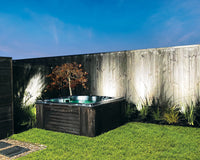
Courtyards focus more on atmosphere than navigation. Incorporate soft vertical wall lighting, accentuate feature trees or pots with highlight lighting, and add subtle ground-level definition. Colour temperature is crucial: 3000K is ideal for residential courtyards, providing a warm and inviting feel that complements natural materials.
4000K suits modern architectural settings, while 6000K is generally only appropriate for security purposes. The uniformity of lighting is more important than its brightness.
What We’re Trying to Achieve
The goal with residential pathways and courtyards is to highlight texture, boost seasonal colours, gently guide movement, and preserve depth and shadows. Proper lighting enhances the landscape, making it feel deliberate and vibrant. Courtyards transition the focus from mere guidance to creating an atmosphere. Combine subtle low-level lighting with vertical fixtures, spotlight plants, and let shadows add depth; brightness should never overwhelm. Our aim is for residential lighting to ensure safe navigation, reduce glare, establish a consistent rhythm, and improve landscape aesthetics without overpowering the garden.
Stay tuned for Part 3, where we will discuss feature trees and planting, emphasising layered lighting that creates depth and drama while remaining restrained. restraint.